
Theurgy as Tantric Yidam Practice
Union with the Divine

noun: theurgy
the·ur·gy /ˈTHēərjē/
the art or technique of compelling or persuading a god or beneficent or supernatural power to do or refrain from doing something. (Marriam-Webster)
One could also define Theurgy (θεουργία theourgía), as “God work,” or the ritual practices of Egyptian Priests, and Neoplatonists, involving the invocation or evocation of deities, seeking henosis, or the “Union with the Divine.”
In a previous article, Western Tantra & the Hermetic Tradition of Alchemy and Magic, published on Substack in January of 2024, I discussed how we might see the Western Esotericism as a Tantric tradition.
Is there such a thing as Western Tantra? If we are talking about an integrated set of spiritual practices for transforming the undeveloped mind and spiritual body of the practitioner - then yes. If we are looking for a sexual practice seen on YouTube then no, not really. But we can make the connections that allows us to develop an enlarged definition of “Western Tantra” as the practice of Alchemical transformation, ritual Magic, Theurgic Union with the Divine, within a larger context of Hermeticism.
Hermeticism can be defined as the Theurgy, Astrology, Ritual Magic, Binding, Devotional Practice, Pharmacon Medicine, and Divination as seen within the Ptolemaic Empire in the Levant and then the Roman Empire, centered on the Egyptian God Thoth, the Hellenic God Hermes, as well as the God of Medicine Asclepius.
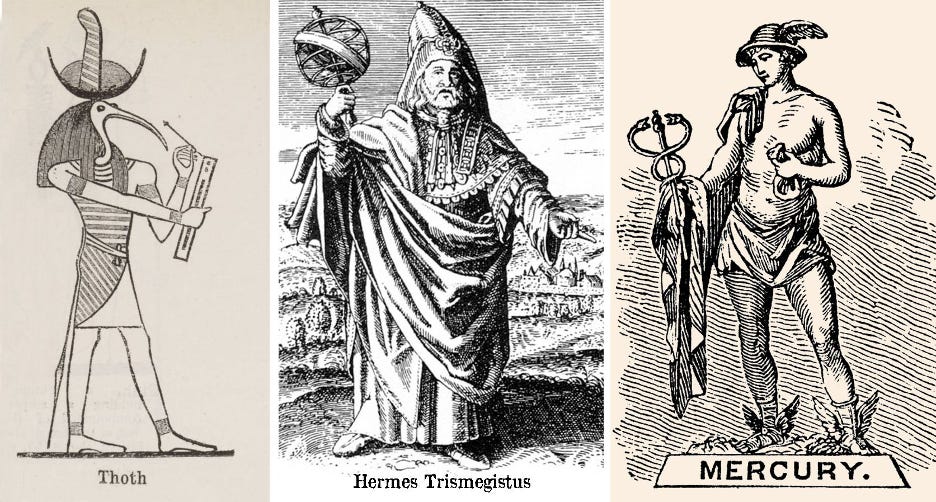
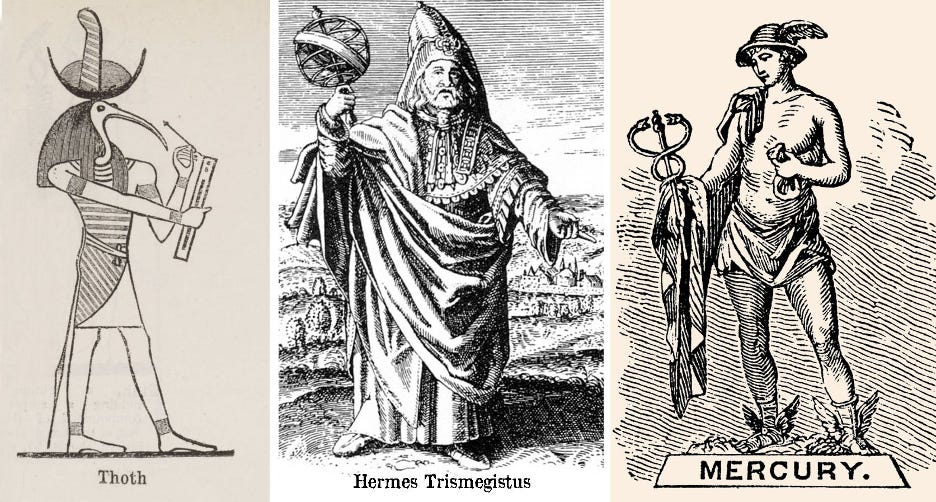
Hermes Trismegistus (from Ancient Greek: Ἑρμῆς ὁ Τρισμέγιστος, "Hermes the Thrice-Greatest") is a legendary Hellenistic period figure that originated as a syncretic combination of the Greek god Hermes and the Egyptian god Thoth.[1] wiki
Instrumental in this practice was the use of Correspondences, Sunthema, Tokens, Icons, Sigils, and the animation of these and the Statues and Temples of Egypt. The “divine synthemes” or Sunthemata of Neoplatonism and the Chaldean Oracles, like hieroglyphs these are symbols of the divine, the “divine words” and names, which facilitate the ascent or descent process of Theurgy (Uždavinys, Philosophy as a Rite of Rebirth, p 135). Thus in Theurgic Ritual, and all other Magic, there are a set of Correspondances that are attributed to the God, and which must be applied appropriately to call forth the Image of the Divine. As in the use of Vedic and Buddhist Mandalas and Christian Icons, these are the noetic manifestation of God in form, Nature being the “word” of God.
The lineage of Hermeticism begins with the Egyptian Theurgy and the god of writing and the arts - Thoth. Then in the 6th century bce we have Pythagoras of Syria who visits Egypt, Nigidius Figulus (Rome) 1st c. BCE, Moderatus of Gades (Spain) 1st c. CE, Apollonius of Tyana a Syrian in the 1st ce, Nicomachus of Gerasa (Jordon) Julian the Chaldean and his son Julian the Theurgist, Plotinus (Alexandria, 204-271 CE), his student Porphery (234-305 CE) , and in the works of his student Iamblichus (c. 245 - c. 325 CE), Zosimos of Panopolis (Egypt) 4th c. CE, and later Proclus (Thracian, 412-485 ce).
Following the Renaissance there would be the development of some of these ideas and practices into the Alchemical tradition of the Transmutation of the base matter of the initiate, his psychological character, through 7 stages not unlike what we see in the Corpus Hermeticum: calcination, dissolution, separation, conjunction, fermentation, distillation, and coagulation. This seven-stage development is also seen in the Mithras Liturgy, a text contained in the Great Magical Papyrus of Paris, most likely composed in the 4th century Egypt. With Modern trends towards the Occult we see the development of ritual Magick by Aleister Crowley with the manifestation of the Body of Light through his ritual of the Holy Guardian Angel, Sex Magic, and the Bornless or Headless Ritual.
The defining texts, or Liturgy, come in two types the Technical Hermetica and the Philosophical Hermetica, but also influenced and associated with Greek Magical Papyrus, the Chaldean Oracles, the Orphic Hymns, Pythagorean Versus, Platos Timeaus and Phaido, The Enneads of Plotinus, and On The Mysteries by Iamblichus. The most important texts that we have do not have authors: the Corpus Hermeticum, the Definitions of Hermes Trismegistus to Asclepius, the Emerald Tablet, and the Nag Hamedi Library.
It is in the Corpus Hermeticum, specifically the Poemandres (CH I), and The Secret Sermon on the Mountain (CH XIII) that we find the texts used in the following treatment. From the Poemandres we have purification rituals of de-energizing the seven, the Hymn to the Eighth, followed by the further purification of the “Twelve Torments” from CH XIII, as well as the Hymn of the Ten, and finally the Hymn of Re-birth.
Why prepare such a practice as I have done Here? From the 1st century to the beginning of the 6th century when these texts were written we see the continuation of a trend in Hellenic Philosophy of redefining the Cosmogony of the Universe around two major new themes: atheism and monotheism or monism. In this period we also see the diaspora of the Jewish communities of the Levant into the Greek and Roman realms and the development with these communities of a Gnostic Hermeticism and Apocalyptic Judaism which would form the basis of Christianity. It is with this that these Hermetic, Chaldean, and Egyptian practices of ritual magic, divination, and Theurgy are banned.
The local gods and rites of Paganism are replaced with a Universal Religion of Empire and the Cult of the Cesar, while Magic is forbidden for all but the Christian Priest and rites of Baptism and the Eucharist. With this God can only be approached through the Church and its officers, and “Union With God,” becoming like a God, the practice of the Philosopher Sage, Theurgist (Jivanmukti of Vedanta, or Bodhisattva of Buddhism) is replaced with the Myth of Christ, the Son of God. The Gnostic vision of the Fall into an Evil Nature, and the forgiveness of Sins through Faith alone in Jesus Christ removes the agency of the practitioner to Self Transformation through direct action. God is separate from Mankind and Nature. It is this that I believe is the poison that has led to a Modern crisis in Meaning only heightened by the Enlightenment Scientific expulsion of all that is of Spirit, the Soul, God, and Beautiful Divine Nature.
As with the Vajrayana practices that I will late out below, a Western practice based in Western Tradition, is a return to Direct access to the Divine, to God as Mind, Logos, Soul, to Beautiful Nature, and the recognition (remembering in Vedanta and Buddhism) of the Divinity of Mankind in a Universe filled with the presence of God and the Divine.
As a Vajrayana initiate and practitioner since 1998, I have undergone all of the practices discussed here: Ngöndro (Tibetan: སྔོན་འགྲོ།), Yidam practice, and Guru Yoga. These three practices I believe can establish a reference frame for the understanding and development of a similar practice in Hermeticism and Theurgy derived from the theoretical and practical discourses of the Corpus Hermeticum, The Greek Magical Papyri, and the Chaldean Oracles. These texts derive from the Hermetic tradition that evolved out of a syncretism of Hellenic Platonism and Egyptian Theurgy between the 3rd century BCE and the 5th century CE, largely in Alexandria.
In Vajrayana these practices are only carried out after education in Sutra, and the physical & mental purification of Ngondro practice: 111,111 prostrations (to purify the energy body), 111,111 repetitions of Diamond Mind purification’s (to purify the subtle body), 111,111 repetitions of Mandala Offerings (for the generation of the Power Field of the Perfect Universe), and 111,111 repetitions of the initiation into the Power Field of the Guru; all requiring initiation & empowerment’s prior to the practice.
With Sutra, this would be for the Hellenic Philosopher the equivalent of the Gymnasium, Trivium, and the Quadrivium -- the education of the Athenian Academy: grammar, logic, and rhetoric; arithmetic, geometry, music, and astronomy. This would also be associated with what Iamblichus would outline in the Pythagorean Way of Life as instrumental in the proper life of a philosopher sage: namely moderation, and vegetarianism, and can also be found as the Golden Verses of Pythagoras. A further procedure to acquire the Right View was the Eleusinian Mysteries, a lengthy procedure of purification and sacred rights culminating in entering into a dark room for several days while taking a concoction of Drugs; the specifics of which we largely do not know but we do know the effect was the Shattering of One’s View, a Re-Birth of sorts. Re-Birth being a mandatory procedure prior to proper Theurgy.
In this article I will use the practice of Guru Yoga to outline the three practices that we see presented in the Hermetic and Theurgic texts mentioned above: the purification and development of the devotee of Hermes Trismagistus, Theurgy of Iamblichus, and the Hymn of Rebirth, as the core practices of Hermeticism.
In Guru Yoga the practitioner goes through a set of procedures:
Generation of Bodhicitta and right View
Refuge under the lineage of teachers
Visualization as Yidam
Generation (Imagination) of Guru (teacher, Helios-Hermes)
Purification through the Seven (colored) Dakinis
Offerings & prayers to the Guru
Integration of the Guru (into the heart)
Activation of energy centers
Mantra recitation
Dissolving
Dedication
Bodhicitta
The Way of the Philosopher or Lover of Wisdom aligns with the Generation of Bodhicitta is the attitude of dedicating oneself to awakening bodhi (/ˈboʊdi/; Sanskrit: बोधि; Pali: bodhi) or Enlightenment through Wisdom and Compassion unselfishly for all humanity. This aligns with the view of Iamblichus, that Theurgy is not for selfish means, one does not command Deity or Daimon, but seeks Union with Divinity (Jivanmukti) through purification and aligning one’s view and life with that of Divinity, invoking the powers and aspects of the Deity in one’s life and attitude.
Right View & Refuge
Right View in Vajrayana is to recognize the Preciousness of Human Birth, the Impermanence of Composite Reality, the law of Cause and Effect (that one must take responsibility for one’s action), and that we are starting from a position of ignorance (the Socratic View) and must seek guidance from a teacher who has traveled the path successfully and can guide you. This is the act of taking Refuge in the lineage, which in this case are the Hermeticists, Magus’s, and Theurgist of Western Esotericism including specifically Iamblichus, Apollonius of Tyana, Plato, Pythagoras, Thoth, and ultimately Hermes Trismegistus.
Visualization & Generation
Visualization as Yidam does not appear in Theurgy, but the use of the Imagination is presented by Iamblichus as essential to the Work. Sunthemata, the use of Symbols and Tokens, the animation of Icons, and the Generation of the Deity being a system of Correspondences with the Names of Deity, Deity being One with many names; Archetypology.
Purification
The Purification through the Seven Dakinis has its likeness in the de-energizing of Seven (Planetary) Powers, and the purification of the 12 Torments (the 12 Zodiacal archetypes of humanity), which are seen as defining the Personal Nature of the Practitioner imparted at Birth, which for a normal human is one’s Fate, Fate which one who is Re-Born through Wisdom overturns.
Offerings, Prayers, & Integration
The Offerings and Prayers to the Guru is paralleled in Deity Yoga, and in Theurgy itself in a short version without the purification practices of the Novice, all of which culminate in the main practice of Theurgy, the Union with Divinity, the generation of the Deity or Guru as one’s Spiritual (Sah) Body, or Body of Light (Astral Body); the Jivanmukti or Birth in God of the Corpus Hermeticum I, Poemandras text. This in both Vajrayana and Theurgy is the attribution of qualities and correspondences that through the imagination generate the image of Deity or Guru within one’s Spiritual Body, seeing oneself as Unified with the Thought Form and Power Field of the Deity or Guru.
Activation & Recitation
Here the practitioner proceeds to intone the sacred vowels visualized placed in the chakras of the practitioner as the Yidam & the Guru followed by Mantra recitation, either as a formula or the Name of the Deity/Guru.
Dissolving & Dedication
These procedures end in dissolving the Imaginal Thought Form back into Mind and Dedicating the Merit of this practice to the Light, Love, and Gnosis of the Holy and Beautiful Universe of God which in Theurgic and Hermetic Neoplatonism = Nous, or Mind. The Hymn’s presented in this Theurgic Practice have their antecedents in the Orphic Hymns and are seen in Vajrayana as well. The important difference here being its practice in the open air facing the Light of the Sun, Symbala/Sunthematha of the Divine Light of God = Nous = Mind.
Deity Practice & Hymns
The second practice which follows this lengthy set is in Vajrayana that of the daily Deity Yoga, the shorter visualization without the purification, which in Hermeticism we know as Theurgy. With the third practice is the singing of the Hymn of Rebirth, in Vajrayana there are various types, the most common being that of calling forth the Protectors, while in the Hermetic practice that I present here, we have a stand-alone prayer to the Deity not unlike the Orphic Hymns.
A final note relates to the different Views presented in the various texts of Neoplatonism, and the Corpus Hermeticum. One being that of the Gnostic position that the Cosmos of Nature is Evil, and that embodiment is Evil and a fall into darkness, thus one seeks to escape the world of the Demiurge. This has its origin the Hebrew Bible and its mythology of the Fall of Man due to Eve and the Snake (wisdom). In the Poemandres Nature, Beautiful Nature enwraps her Body around the Spirit/Mind of God forming Life and Man (CH I, 8-14).
And when she saw that Form of beauty which can never satiate,
and him who [now] possessed within himself each single energy
of [all seven] Rulers as well as God's own Form,
she smiled with love;
for ‘twas as though she'd seen the image of Man's fairest form upon her Water,
his shadow on her Earth.
He in turn beholding the form like to himself,
existing in her, in her Water,
loved it and willed to live in it;
and with the will came act,
and [so] he vivified the form devoid of reason.
And Nature took the object of her love and wound herself completely around him,
and they were intermingled, for they were lovers.
This other form has its foundation in Egyptian Metaphysics and its View that the World (Egypt) is the Temple of the Universe, and that Man, specifically the Priests and Philosophers, have a coequal position with God in the maintenance of the Divine Order through Theurgic practice and Union with the Divine. This is a Religion of Light and Love.
Both Vajrayana and the Theurgic Neoplatonism of Iamblichus are both Monist, the Uni-verse is of the One, as the All, the Logos, and Nature as a Mirror of the Divine. God, Logos, Nature, and Man are All Co-established, Co-creators, and Co-extensive – Monism.
For these reasons in the text taken from the Corpus Hermeticum I have altered certain words to reflect this position; God and Demiurge should be seen as Male-Female combined, therefore I have when needed changed God/Father to Source/Nous/Mind, He & His to Thee, Him & Himself to Thyself, Son to Child; there is one case of the use of Soul which I have left, it may be that Mind would be an adequate replacement.
Text to be spoken out loud is in italics, with the original texts used from the Corpus Hermeticum in italic but with C.H. and a Roman Numeral (and line number) designating the text of origin.
Theurgic Novice Purification and Initiation
I _____ make myself ready to approach divinity,
Dressed in simple white linen (prayer shawl), bare foot as a newborn,
Having cleansed my body with pure water,
Having washed my feet, my privates, my hands, and my face, and anointed with olive oil, I humbly prostrate myself.
I purify my mind and intentions, seeking the bliss of union with divinity.
I pray to thee oh God, grant me gnosis through your will.
In the lineage of Iamblichus, Apollonius of Tyana, and Pythagoras, I beseech thee.
I am ignorant and seek enlightenment through your Gnosis.
I now generate the Mandala of Protection
With Offerings and Sunthemata
Of Incense and Frankincense,
Candles, Heliotrope, and Golden Crown,
Wine, Olive Oil, and Cock,
Rainbow Colors, Peacock and Coin
I make a space of quiet remove within the world
I square the circle within this Temple of life
I make pure oblations to the Source, Mind of Becoming
I make pure oblations to the Logos, Mind of Knowing
I make pure oblations to the Cosmos, Mind of Generation
I make offerings of fire, water, earth, and air
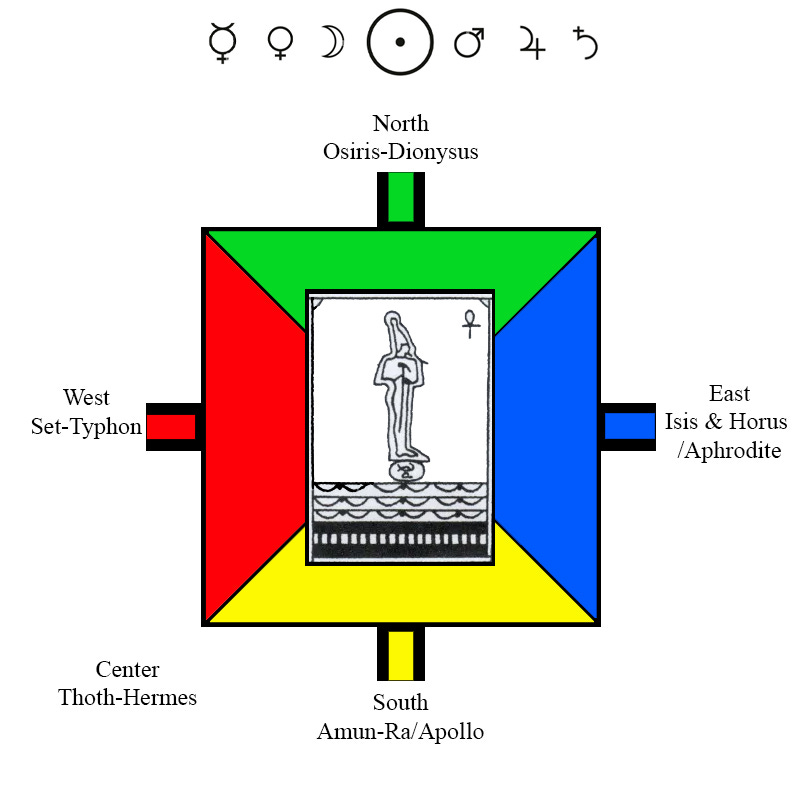
I make offerings to the four Gate Holders:
In the East of Green, White Isis I call forth, protect me
In the South of Yellow, Golden Ra-Horus I call forth, protect me
In the West of Red, Red Seth I call forth, protect me
In the North of Blue, Grey Thoth I call forth, protect me
Within the Holy of Holies, In the center of Being,
Black Night, Green Osiris I call forth, guide me through the darkness.
I make offerings to Osiris Dionysus of Wine,
And here two coins, and a Green Sprig from a Dove.
Thus Contemplating
(C.H. I, 25) To the first zone thee give the Energy of Growth and Waning.
Unto the second [zone], Device of Evils [now] de−energized.
Unto the third, the Guile of the Desires, de−energized.
Unto the fourth, thy Domineering Arrogance, de−energized.
Unto the fifth, unholy Daring and the Rashness of Audacity, de−energized.
Unto the sixth, Striving for Wealth by evil means, deprived of its aggrandizement.
And unto to the seventh zone, Ensnaring Falsehood, de−energized. (C.H. I)
(C.H. I, 26) And then, with all the energies of the harmony stript from thyself
clothed in thee proper Power,
thee cometh to that Nature which belongs unto the Eighth,
and there with those−that−are hymneth the Source of All, proclaim to divinity.
(C.H. I, 31) Holy art Thou, O God, the universals' Source.
Holy art Thou, O God, whose Will perfects itself by means of its own Powers.
Holy art Thou, O God, who willeth to be known and art known by Thine own.
Holy art Thou, who didst by Word (Logos) make to consist the things that are.
Holy art Thou, of whom All−nature hath been made an image.
Holy art Thou, whose Form Nature hath never made.
Holy art Thou, more powerful than all power.
Holy art Thou, transcending all pre−eminence.
Holy Thou art, Thou better than all praise. (C.H. I)
(C.H. XIII, 7)
Withdraw into thyself, and it will come by thy will, throw out of work the body's senses,
and thy Divinity shall come to birth; purge from thyself the brutish torments − things of matter.
(C.H. XIII, 7-9) Torment the first is this Not−knowing, purge from thyself
the second one is Grief, purge from thyself
the third, Intemperance, purge from thyself
the fourth, Concupiscence, purge from thyself
the fifth, Unrighteousness, purge from thyself
the sixth is Avarice, purge from thyself
the seventh, Error, purge from thyself
the eighth is Envy, purge from thyself
the ninth, Guile, purge from thyself
the tenth is Anger, purge from thyself
eleventh, Rashness, purge from thyself
the twelfth is Malice, purge from thyself (C.H. XIII)
(C.H. XIII, 9-12) And now no more doth any torment of the Darkness venture nigh,
but vanquished [all] have fled with whirring wings.
And when the Ten has come, my child,
that driveth out the Twelve,
the Birth in understanding is complete,
and by this birth we are made into Gods.
Who then doth by thine mercy gain this Birth in God,
abandoning the body's senses,
knows thyself [to be of Light and Life],
and that thee doth consist of these,
and [thus] is filled with bliss.
circle of the twelve types−of−life,
this being composed of elements,
the Ten is that which giveth birth to souls/minds.
And Life and Light are unified there,
where the One hath being from the Spirit.
According then to reason (logos) the One contains the Ten,
the Ten the One. (C.H. XIII)
As Above, So Below (Emerald Tablet)
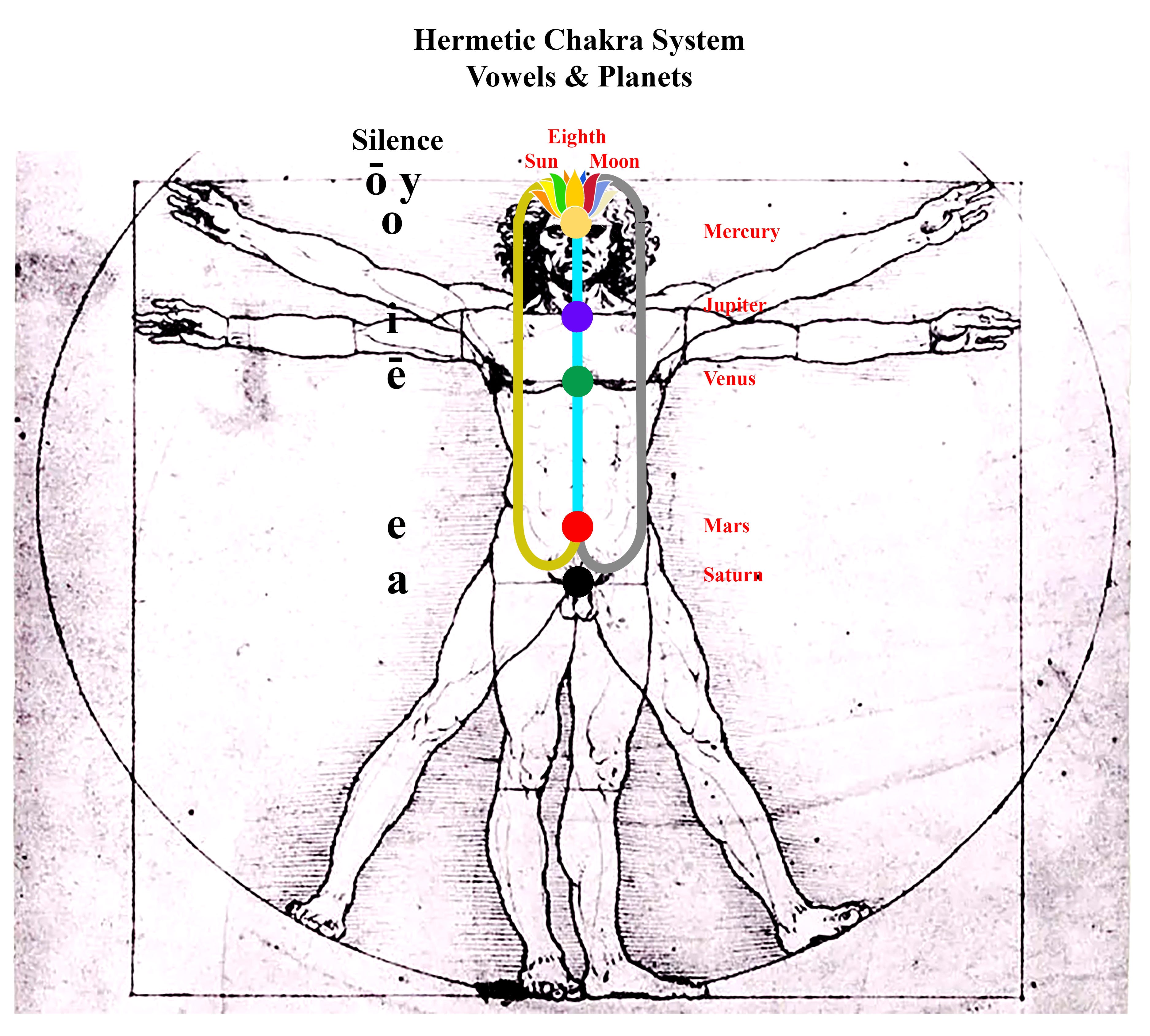
I intone the sacred vowels Seven times
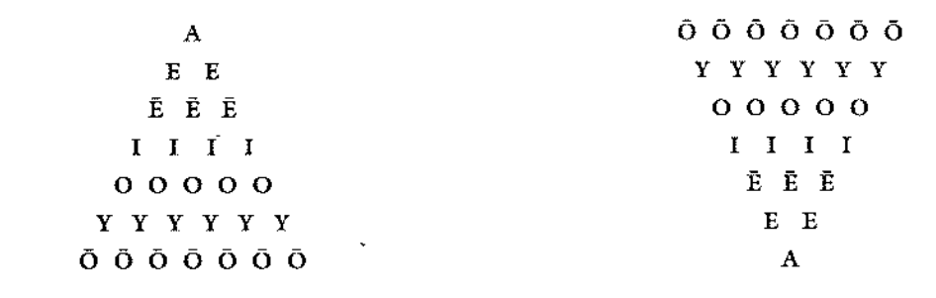
Now I generate the Deity, Hermes Trismegistus
Generate an image of the Deity using the Correspondences of Sunthemata (Symbols) proper:
The Body of Light
White Androgynous Youth
Wearing a White Chiton, and Travelers Hat
Winged Sandals
An Aura of Gold, with a Rainbow above
Holding his Caduceus, a Winged Staff, with Golden Orb and All-Seeing Eye
Entwined with One or Two Snakes
Mind of the Logos, Hermes, I praise your name
First Light of the Universe, Hermes, I praise your name
All Powerful spirit of the Universe, Hermes, I praise your name
Bliss of the Universe, Hermes, I praise your name
Hermes let me be a humble vessel of your Gnosis
Hermes let me be a humble vessel of your Love
Hermes let me be a humble vessel of your Creative Powers
Hermes let me be a humble vessel of your Bliss
Recite the Hymn three times, followed by a short Mantra 100 times.
Hermes Trismegistus
Or recite the Mantra
Hermes of Gnosis,
Hermes of Love,
Hermes of Creative Bliss
When you finish the Mantra, sit quietly and dissolve the visualization Into Light, melting all form and being, Completing the At-One-Ment with Deity.
Remain in Silence for a period until you feel Resolved
Filled with the Bliss of the Body of Light
Carry this forward into the world with you.
Dedicate the Merit of this rite with Love,
To God, Logos, Nature, and Life.
Thou hast been born a God, Child of the One (C.H. XIII)
sing the Hymn of Re−birth (C.H. XIII)
(C.H. XIII, 17-20) Let every nature of the World receive the utterance of my hymn!
Open thou Earth! Let every bolt of the Abyss be drawn for me.
Stir not, ye Trees!
I am about to hymn creation's Lord, both All and One.
Ye Heavens open and ye Winds stay still;
[and] let God's deathless Sphere receive my word (logos)!
For I will sing the praise of Him who founded all;
who fixed the Earth, and hung up Heaven,
and gave command that Ocean should afford sweet water [to the Earth],
to both those parts that are inhabited and those that are not,
for the support and use of every man;
who made the Fire to shine for gods and men for every act.
Let us together all give praise to Thee,
sublime above the Heavens,
of every nature Lord!
'Tis He who is the Eye of Mind;
may Thee accept the praise of these my Powers!
Ye powers that are within me,
hymn the One and All; sing with my Will,
Powers all that are within me!
O blessed Gnosis, by thee illumined,
hymning through thee the Light that mind alone can see,
I joy in Joy of Mind.
Sing with me praises all ye Powers!
Sing praise, my Self−control; sing thou through me,
my Righteousness, the praises of the Righteous;
sing thou, my Sharing−all, the praises of the All;
through me sing, Truth, Truth's praises!
Sing thou, O Good, the Good!
O Life and Light, from us to you our praises flow!
Source of All, I give Thee thanks, to Thee Thou Energy of all my Powers;
I give Thee thanks, O God, Thou Power of all my Energies!
Thy Reason (Logos) sings through me Thy praises.
Take back through me the All into [Thy] Reason − [my] reasonable oblation!
Thus cry the Powers in me. They sing Thy praise, Thou All;
they do Thy Will.
From Thee Thy Will; to Thee the All.
Receive from all their reasonable oblation.
The All that is in us, O Life, preserve;
O Light, illumine it;
O God, in−spirit it.
It it Thy Mind that plays the shepherd to Thy Word,
O Thou Creator, Bestower of the Spirit [upon all].
[For] Thou art God,
Thy Man thus cries to Thee through Fire,
through Air, through Earth, through Water,
[and] through Spirit, through Thy creatures.
'Tis from Thy Aeon I have found praise−giving;
and in thy Will, the object of my search, have I found rest. (C.H. XIII)
This is the end of the Purification & Initiation into Hermetic Theurgy
The Theurgy Practice of
Hermes Trismegistus
I _____ make myself ready to approach divinity,
Dressed in simple white linen (prayer shawl), bare foot as a newborn,
Having cleansed my body with pure water,
Having washed my feet, my privates, my hands, and my face, and anointed with olive oil, I humbly prostrate myself.
I purify my mind and intentions, seeking the bliss of union with divinity.
I pray to thee oh God, grant me gnosis through your will.
In the lineage of Iamblichus, Apollonius of Tyana, and Pythagoras, I beseech thee.
I am ignorant and seek enlightenment through your Gnosis.
I intone the sacred vowels Seven times
Now I generate the Deity, Hermes Trismegistus
Generate an image of the Deity using the Correspondences of Sunthemata (Symbols) proper:
The Body of Light
White Androgynous Youth
Wearing a White Chiton, and Travelers Hat
Winged Sandals
An Aura of Gold, with a Rainbow above
Holding his Caduceus, a Winged Staff, with Golden Orb and All-Seeing Eye
Entwined with One or Two Snakes
Mind of the Logos, Hermes, I praise your name
First Light of the Universe, Hermes, I praise your name
All Powerful spirit of the Universe, Hermes, I praise your name
Bliss of the Universe, Hermes, I praise your name
Hermes let me be a humble vessel of your Gnosis
Hermes let me be a humble vessel of your Love
Hermes let me be a humble vessel of your Creative Powers
Hermes let me be a humble vessel of your Bliss
Recite the Hymn three times, followed by a short Mantra 100 times.
Hermes Trismegistus
Or recite the Mantra
Hermes of Gnosis (Nous)
Hermes of Love (Eros)
Hermes of Creative Bliss (Cosmos)
When you finish the Mantra, sit quietly and dissolve the visualization Into Light, melting all form and being, Completing the At-One-Ment with Deity.
Remain in Silence for a period until you feel Resolved
Filled with the Bliss of the Body of Light
Carry this forward into the world with you.
Dedicate the Merit of this rite with Love,
To God, Logos, Nature, and Life.
Thou hast been born a God, Child of the One (C.H. XIII)
sing the Hymn of Re−birth (C.H. XIII)
Devotional Hymn for Morning and Night
(C.H. XIII, 16-20) Thou hast been born a God, Child of the One,
sing the Hymn of Re−birth
Stand in a place uncovered to the sky,
facing the southern wind,
about the sinking of the setting sun,
and make thy worship;
so in like manner too when he doth rise,
with face to the east wind.
Be Still
Let every nature of the World receive the utterance of my hymn!
Open thou Earth! Let every bolt of the Abyss be drawn for me.
Stir not, ye Trees!
I am about to hymn creation's Lord, both All and One.
Ye Heavens open and ye Winds stay still;
[and] let God's deathless Sphere receive my word (logos)!
For I will sing the praise of Him who founded all;
who fixed the Earth, and hung up Heaven,
and gave command that Ocean should afford sweet water [to the Earth],
to both those parts that are inhabited and those that are not,
for the support and use of every man;
who made the Fire to shine for gods and men for every act.
Let us together all give praise to Thee,
sublime above the Heavens,
of every nature Lord!
'Tis He who is the Eye of Mind;
may Thee accept the praise of these my Powers!
Ye powers that are within me,
hymn the One and All; sing with my Will,
Powers all that are within me!
O blessed Gnosis, by thee illumined,
hymning through thee the Light that mind alone can see,
I joy in Joy of Mind.
Sing with me praises all ye Powers!
Sing praise, my Self−control; sing thou through me,
my Righteousness, the praises of the Righteous;
sing thou, my Sharing−all, the praises of the All;
through me sing, Truth, Truth's praises!
Sing thou, O Good, the Good!
O Life and Light, from us to you our praises flow!
Source of All, I give Thee thanks, to Thee Thou Energy of all my Powers;
I give Thee thanks, O God, Thou Power of all my Energies!
Thy Reason (Logos) sings through me Thy praises.
Take back through me the All into [Thy] Reason − [my] reasonable oblation!
Thus cry the Powers in me. They sing Thy praise, Thou All;
they do Thy Will.
From Thee Thy Will; to Thee the All.
Receive from all their reasonable oblation.
The All that is in us, O Life, preserve;
O Light, illumine it;
O God, in−spirit it.
It it Thy Mind that plays the shepherd to Thy Word,
O Thou Creator, Bestower of the Spirit [upon all].
[For] Thou art God,
Thy Man thus cries to Thee through Fire,
through Air, through Earth, through Water,
[and] through Spirit, through Thy creatures.
'Tis from Thy Aeon I have found praise−giving;
and in thy Will, the object of my search, have I found rest. (C.H. XIII)
Bibliography
Pythagoras:
The Life of Pythagoras, Iamblichus
English translation: Thomas Taylor, 1818
The Life of Pythagoras, Porphyry
The Complete Pythagoras, edited by Patrick Rousell, Internet Archive PDF
Plato:
Timaeus, c. 360 bce, Translated by David Horan, 2021
Phaedo, c. 360 bce, Translated by Gwenda-lin Grewal, 2006
Plotinus:
The Enneads, ISBN 10: 1789873541 / ISBN 13: 9781789873542
Published by Pantianos Classics, 1917
Iamblichus:
On the Mysteries, English translations: Thomas Taylor, 1821;[20][21] Alexander Wilder, 1911;[22][23] Emma C. Clarke, John M. Dillon, and Jackson P. Hershbell, 2003, ISBN 1-58983-058-X.
On General Mathematical Science, English translations: John M. Dillon & J. O. Urmson (2021; Bloomsbury Publishing)
Protrepticus, English translation: Thomas Moore Johnson, Iamblichus' Exhortation to the Study of Philosophy, Osceola, Mo., 1907 (repr. 1988, ISBN 0-933999-63-1).
In Nicomachi arithmeticam introductionem, Teubner, ed. Pistelli, Teubner, 1894[29] (rev. Klein, 1975)
Letters: John M. Dillon and Wolfgang Polleichtner, Iamblichus of Chalcis: The Letters, 2009, ISBN 1-58983-161-6.
John F. Finamore and John M. Dillon, Iamblichus' De Anima: Text, Translation, and Commentary, Leiden: Brill, 2002, ISBN 1-58983-468-2.
Fragmentary commentaries on Plato
Bent Dalsgaard Larsen, Jamblique de Chalcis: Exégète et philosophe (vol. 2, appendix: Testimonia et fragmenta exegetica), Universitetsforlaget i Aarhus, 1972 (Greek texts only).
John M. Dillon (ed. and trans.), Iamblichi Chalcidensis in Platonis dialogos commentariorum fragmenta, Leiden: Brill, 1973.
Theological Principles of Arithmetic (Theologumena arithmeticae, an anonymous work ascribed to Iamblichus or Anatolius of Laodicea), ed. Friedrich Ast, Leipzig, 1817; ed. Vittorio de Falco, Teubner, 1922.
English translation: Robin Waterfield, Pseudo-Iamblichus: The Theology of Arithmetic, translation, introduction, notes; foreword by K. Critchlow, Phanes Press, 1988, ISBN 0-933999-72-0.
Hermetica and other works:
Definitions of Hermes Trismegistus to Asclepius, Hermetic treatise belonging to the same subgenre of 'religio-philosophical' Hermetica
The Discourse on the Eighth and Ninth, Hermetic treatise belonging to the same subgenre of 'religio-philosophical' Hermetica
The Emerald Tablet, found in the Book of the Secret of Creation, Kitâb sirr al-Halîka in Arabic. This text presents itself as a translation of Apollonius of Tyana, under his Arabic name Balînûs.[10]
The Orphic Hymns, translated by Apostolos N. Athanassakis and Benjamin M. Wolkow, The Johns Hopkins University Press, 2013, ISBN 978-1-4214-0881-1
Mithras Liturgy, a text contained in the Great Magical Papyrus of Paris
Brashler, James; Dirkse, Peter A.; Parrott, Douglas M. (1990). "The Discourse on the Eighth and Ninth VI,6". In Robinson, James M. (ed.). The Nag Hammadi Library in English (3rd ed.). New York: HarperCollins. pp. 321–327. ISBN 978-0060669355.
Brashler, James; Dirkse, Peter A.; Parrott, Douglas M. (1990). "Prayer of Thanksgiving (VI,7) and Scribal Note (VI,7a)". In Robinson, James M. (ed.). The Nag Hammadi Library in English (3rd ed.). New York: HarperCollins. pp. 328–329. ISBN 978-0060669355.
Brashler, James; Dirkse, Peter A.; Parrott, Douglas M. (1990). "Asclepius 21–29 VI,8". In Robinson, James M. (ed.). The Nag Hammadi Library in English (3rd ed.). New York: HarperCollins. pp. 330–338. ISBN 978-0060669355.
Copenhaver, Brian P. (1992). Hermetica: The Greek Corpus Hermeticum and the Latin Asclepius in a New English Translation, with Notes and Introduction. Cambridge: Cambridge University Press. ISBN 0-521-42543-3.
Litwa, M. David, ed. (2018). Hermetica II: The Excerpts of Stobaeus, Papyrus Fragments, and Ancient Testimonies in an English Translation with Notes and Introductions. Cambridge: Cambridge University Press. doi:10.1017/9781316856567. ISBN 978-1-107-18253-0. S2CID 217372464.
Mahé, Jean-Pierre (1999). "The Definitions of Hermes Trismegistus to Asclepius". In Salaman, Clement; van Oyen, Dorine; Wharton, William D.; Mahé, Jean-Pierre (eds.). The Way of Hermes. London: Duckworth Books. pp. 99–122. ISBN 9780892811861.
Scott, Walter (1924–1936). Hermetica: The Ancient Greek and Latin Writings Which Contain Religious or Philosophic Teachings Ascribed to Hermes Trismegistus. Vol. I–IV. Oxford: Clarendon Press. OCLC 601704008. (older edition and translation of the Corpus Hermeticum, the Asclepius, the Stobaean excerpts, and various testimonia; vol. IV [pp. 277–352] also contains an English translation of Bardenhewer's Latin translation of the Arabic Kitāb fi zajr al-nafs or "Book of the Rebuke of the Soul")
Stapleton, H. E.; Lewis, G. L.; Taylor, F. Sherwood (1949). "The sayings of Hermes quoted in the Māʾ al-waraqī of Ibn Umail". Ambix. 3 (3–4): 69–90. doi:10.1179/amb.1949.3.3-4.69. (contains Hermetic fragments with, a.o., a commentary on the Emerald Tablet)
Waegeman, Maryse (1987). Amulet and Alphabet: Magical Amulets in the First Book of Cyranides. Amsterdam: J. C. Gieben. ISBN 90-70265-80-X. OCLC 17009220.
The treatises contained in the Corpus Hermeticum are:[12][13]
I. Discourse of Poimandres to Hermes Trismegistus
II. Hermes to Asclepius
III. A sacred discourse of Hermes
IV. A discourse of Hermes to Tat: The mixing bowl or the monad
V. A discourse of Hermes to Tat, his son: That god is invisible and entirely visible
VI. Hermes to Asclepius: That the good is in god alone and nowhere else
VII. That the greatest evil in mankind is ignorance concerning god
VIII. Hermes to Tat: That none of the things that are is destroyed, and they are mistaken who say that changes are deaths and destructions
IX. Hermes to Asclepius: On understanding and sensation: [That the beautiful and good are in god alone and nowhere else]
X. Hermes to Tat: The key
XI. Mind (Nous) to Hermes
XII. Hermes to Tat: On the mind shared in common
XIII. Hermes to Tat, a secret dialogue on the mountain: On being born again, and on the promise to be silent
XIV. Hermes to Asclepius: health of mind
XVI.[a] Asclepius to King Ammon: Definitions on god, matter, vice, fate, the sun, intellectual essence, divine essence, mankind, the arrangement of the plenitude, the seven stars, and mankind according to the image
XVII. Asclepius to King Ammon
XVIII. Tat to a king: On the soul hindered by the body's affections
Further reading:
Aleister Crowley:
Magick in Theory and Practice. Paris: Lecram Press. 1929
Crowley, Aleister (1973). 777 and other Qabalistic writings of Aleister Crowley. York Beach, ME: Samuel Weiser. ISBN 0-87728-222-6.
Crowley, Aleister (2004). 777 Revised. Leeds: Celephais Press.
Gregory Shaw:
Hellenic Tantra: The Therugic Pplatonism of Iamblichus, Angelico Press, 2024, ISBN 979-8892800006
Theurgy and the Soul: The Neoplatonism of Iamblichus, Angelico Press/Sophia Perennis 2015, ISBN 978-1621380641
Algis Uždavinys:
Philosophy as a Rite of Rebirth: From Ancient Egypt to Neoplatonism, The Prometheus Trust, 2008, ISBN 1898910359
Philosophy and Theurgy in Late Antiquity, Angelico Press, 2014, ISBN 1597310867
Wouter Hanegraaff:
Esotericism and the Academy: Rejected Knowledge in Western Culture, Cambridge University Press, Cambridge 2012, ISBN 9780521196215
Western Esotericism: A Guide for the Perplexed, Bloomsbury, London 2013,
Hermetic Spirituality and the Historical Imagination: Altered states of knowledge in late antiquity, Cambridge University Press, 2022, ISBN 9781009123068
Antoine Faivre
Eternal Hermes: From Greek God to Alchemical Magus, Phanes Press, 2000, ISBN 0933999526
Just want to politely push back on a couple things.
You said:
"With this God can only be approached through the Church and its officers, and “Union With God,” becoming like a God, the practice of the Philosopher Sage, Theurgist (Jivanmukti of Vedanta, or Bodhisattva of Buddhism) is replaced with the Myth of Christ, the Son of God. The Gnostic vision of the Fall into an Evil Nature, and the forgiveness of Sins through Faith alone in Jesus Christ removes the agency of the practitioner to Self Transformation through direct action. God is separate from Mankind and Nature."
RE: Union with God. There is a process called Theosis in Eastern Orthodoxy. It is pretty much the same thing as Platonic Henosis. It is in fact the very goal of Orthodox Christianity. It is accomplished through dying to the world (not in the dualistic, anti-cosmic sense, but in the sense of dying to the passions, which are the particular names for "the World") - which is what Socrates tells Simmias and Cebes in the Phaedo, “I am afraid that other people do not realize that the one aim of those who practice philosophy in the proper manner is to practice for death and dying.” [Plato. Phaedo. Translated by G.M.A. Grube. In Plato: Complete Works, edited by John M. Cooper and D. S. Hutchinson, p. 55. Indianapolis: Hackett, 1997.] This idea, that the primary aim of true philosophy is a practice for death (meleté thanatou), is what Eastern Orthodoxy is.
Watch this Q&D:
https://youtu.be/E2x2WTWjcEA?si=ciqmrQP1Gea63nsr
Or read this:
https://www.holycross.org/products/theosis-the-true-purpose-of-human-life#:~:text=This%20book%2C%20written%20by%20a,that%20man%20could%20become%20god.%E2%80%9D
RE: God being fully transcendent and out of touch with mankind and nature. This is called the Ousia kai Energeia argument. Essences and acticities. We can never know God's essence, but we know him through his activities in nature. Think of these maybe as sunthematic actions - not material sumbola. Granted, they do not have this, or the notion of Theosis in the Western (Catholic) church.
See: the work of the Pseudo-Dionysius, Gregory Palamas, or any of the Cappadocian Fathers.
Or this - Q&D:
https://youtu.be/EUWRgotmeF4?si=HnkmJL_q2fK_u1kV
I think a lot of people would say that the single most concentrated existing current of (late-) Platonism is in the Eastern Orthodox church. And I think some of them would be able to defend that argument.
I hope you don't take my critique as an attack. You sound like you're intelligent, but your anti-Christian position (the "Myth" of Christ, etc.) is obvious. And I wouldn't want anyone to read what you wrote and think that it's actually the case.
Also, why no mention of Greg Shaw in the body of the work? The whole Hellenic Tantra kind of his thesis, no?
You outdid yourself there.
Many Thanks